

Before you start
- You need the Admin role.
- Your Manage API keys access must be on. See Team and permissions.
- In a subaccount, the parent account must allow API Keys for that subaccount.
Create an API key
1
Open API Keys
Click your name in the sidebar, choose Settings, and open API Keys.
2
Start a new key
Click Create at the top of the section. If you have no keys yet, click Add API key.
3
Name the key
In Create new API key, enter an API Key name that says where the key is used, for example
crm-sync-production. Click Create.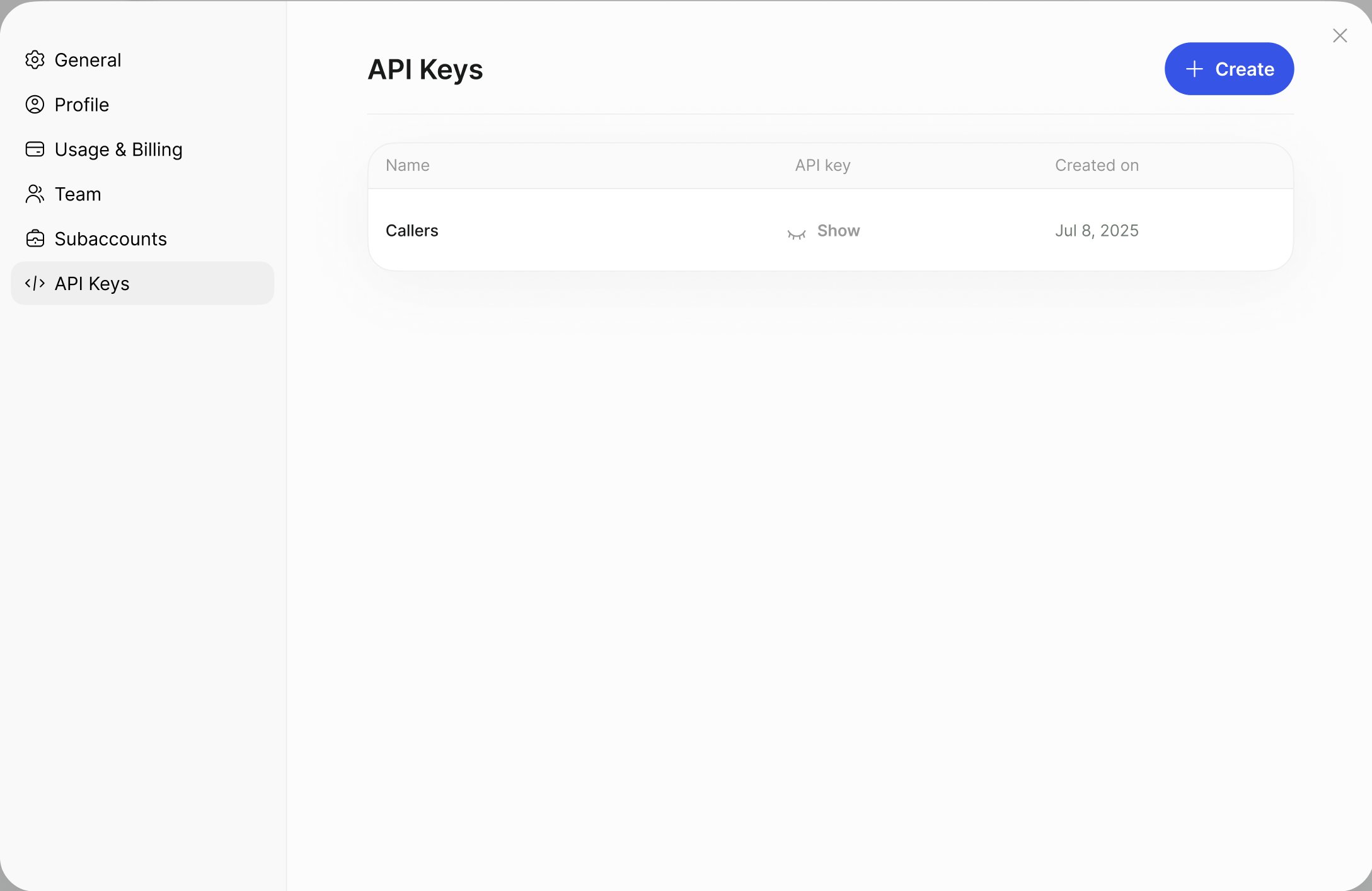
Settings → API Keys, with the Create button and the Show link for each key.
Copy a key
In the API key column, click Show to display the key, then click the copy icon next to it. Store the key in your secrets manager or environment variables right away.Delete (revoke) a key
Hover over the key’s row and click the delete icon. Confirm with Yes, revoke. Requests that use the key are rejected from then on, so update your integrations first. Keys don’t expire. Delete keys you no longer use.Use your API key
Send the key as the raw value of theAuthorization header. Don’t add a Bearer prefix.
Act on behalf of a subaccount
A key created in a main (parent) account can also act on any of its subaccounts. Add thex-sub-organization-id header with the subaccount’s ID. Without the header, requests act on the account that owns the key.
Security best practices
- Keep keys server-side. Never put an API key in browser code, mobile apps, or public repositories. To add a voice agent to a website, use the web widget instead.
- Use one key per integration. Separate keys let you revoke one integration without breaking the others, and the key name shows where each one is used.
- Store keys in a secrets manager or environment variables, not in source code or spreadsheets.
- Rotate keys. Create a new key, deploy it, then revoke the old one. Do this right away if a key may have leaked.
- Limit who can see keys. Turn off Manage API keys for Admins who don’t need it.
- Verify traffic in the other direction too. API keys authenticate your requests to Callers. To confirm that webhooks and HTTP actions really come from Callers, check their signatures. See Validating webhook signatures.
Troubleshooting
I don't see the API Keys section
I don't see the API Keys section
Only Admins with Manage API keys access see it. In a subaccount, the parent account must also allow API keys. Ask an Admin, or email .
The API returns data from the wrong account
The API returns data from the wrong account
Each key acts on the account where it was created. Create the key in the right account, or use a parent account key with
x-sub-organization-id.Related
API introduction
Base URL, response format, errors, and pagination.
Managing subaccounts
Create and manage client accounts.
Team and permissions
Control who can manage API keys.
Validating webhook signatures
Verify requests that Callers sends to you.